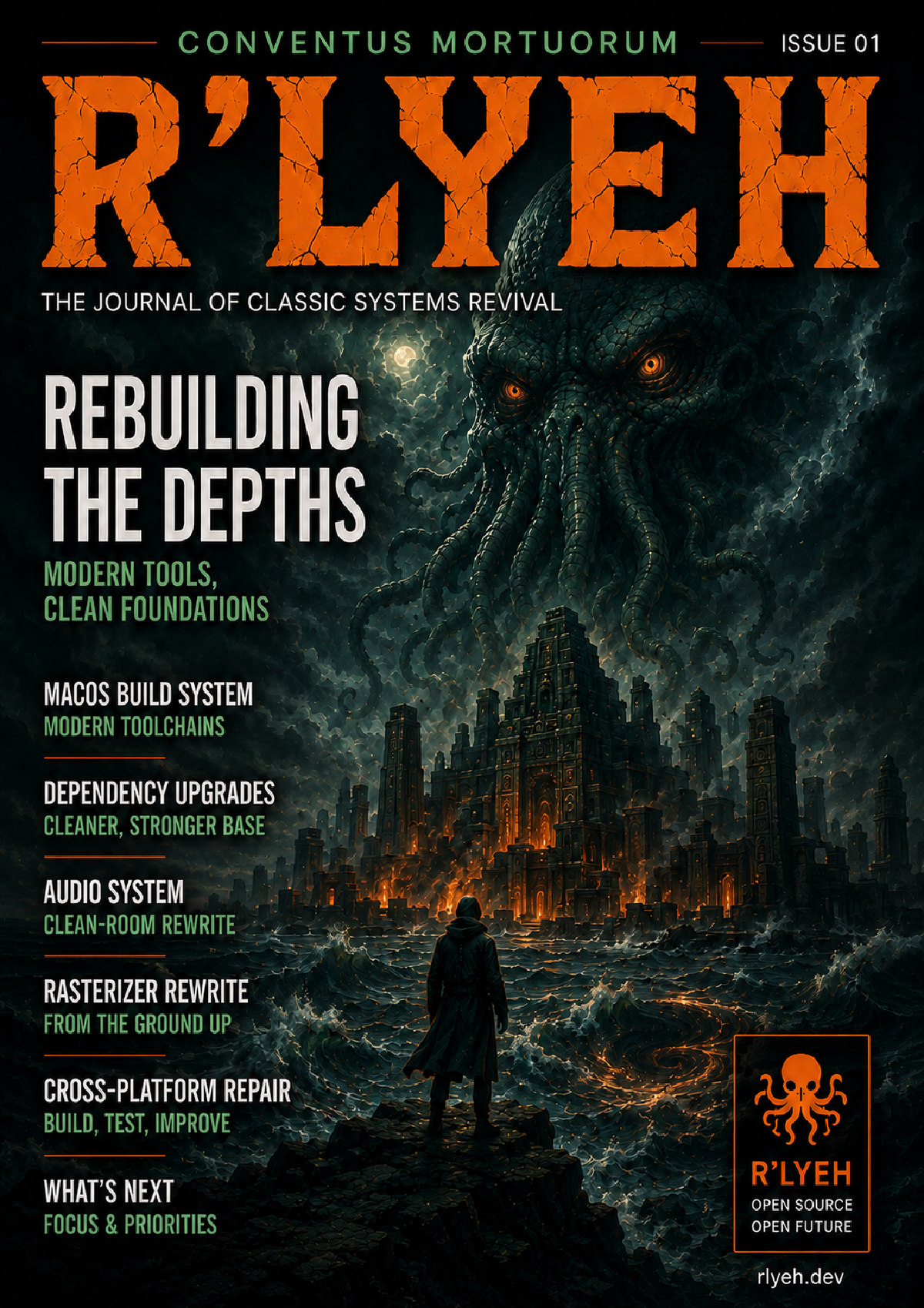

Rebuilding the Depths
No city sinks all at once.
Long before the sea claims its towers, the roads disappear beneath drifting sand. The names of its builders fade from memory. Stones are borrowed for newer monuments. The great halls remain standing only because no one remembers they are there.
Eventually, those who stumble upon the ruins mistake them for something natural, believing the impossible geometry had always belonged to the ocean floor.
Recovering such a place is rarely an act of discovery. It is an act of patience.
Since our last report, much of that patience has been spent beneath the surface, clearing centuries of sediment from foundations that were never intended to bear the weight of modern tides. Ancient pathways have been traced anew, forgotten tools replaced with those forged in the present age, and old rituals rewritten so they may once again be performed without relying upon artifacts whose provenance has long since vanished.
The work is seldom glamorous.
One corridor collapsed entirely and demanded reconstruction from the bedrock upward. Elsewhere, faded diagrams proved incompatible with newer instruments, requiring careful translation before the surrounding structure could be trusted again. Several chambers yielded relics whose origins could not be confidently established. Rather than enshrine uncertainty within the city itself, they were respectfully retired and replaced with works of our own making, carved to honor the original purpose without borrowing the original stone.
Even the voices echoing through the halls have changed.
The old resonance remains familiar, but the mechanisms producing it have been rebuilt, cleaner and more faithful to the architecture that surrounds them. Likewise, light now reaches corners once illuminated by aging lanterns whose designs belonged to another era. None of these changes seek to alter the city. They merely allow it to endure.
Elsewhere, expeditions have ventured beyond the central ruins.
One route now reaches the western cliffs with confidence, proving that the old causeways still bear weight under careful footing. Other paths remain unfinished, disappearing into cold fog where unfamiliar terrain and shifting rock continue to resist reliable passage. Such is the nature of surveying forgotten kingdoms. Not every map is completed during the first expedition.
Perhaps the most important discoveries were not visible at all.
Every recovered artifact has been cataloged. Every newly placed stone records where it came from and why it belongs. Future caretakers should never be forced to wonder whether a column was ancient, restored, or newly raised. Preservation demands more than rebuilding. It demands memory.
Many have asked why so much effort is spent replacing pieces that, from a distance, appeared to function well enough.
Ruins are deceptive.
A wall may stand for centuries while the mortar beneath it quietly turns to dust. A bridge may carry one final traveler before surrendering to the sea. Foundations ignored eventually become foundations lost, and restoring them after collapse is always more difficult than strengthening them before the first crack appears.
So we rebuild while the city still remembers its own shape.
There is still much to uncover. New gateways wait to be opened. Familiar passages will be widened. Older roads will eventually give way to stronger ones, allowing expeditions to reach distant shores that have remained inaccessible for far too long.
The work continues.
Somewhere below the surface, something has begun to stir.