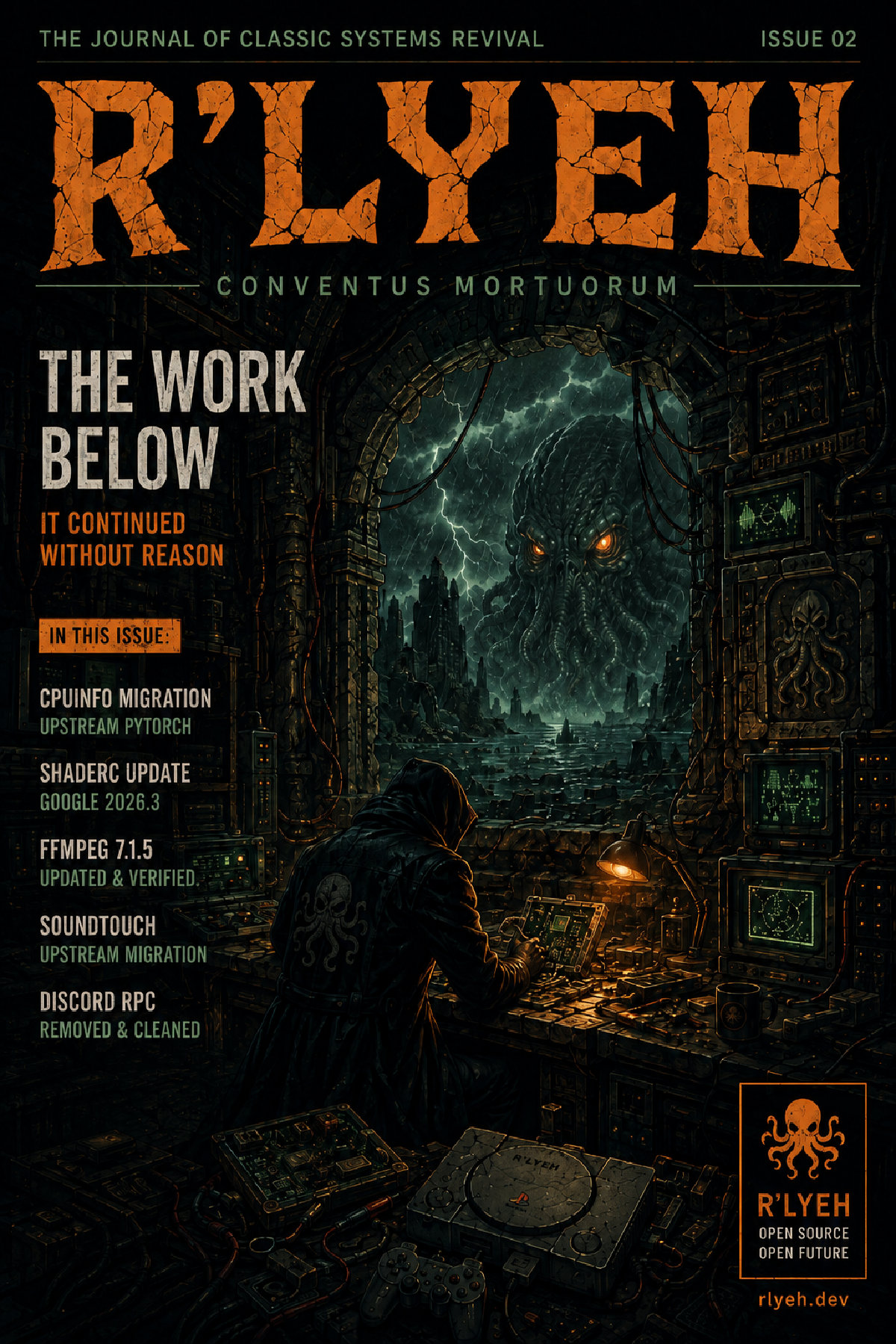

It continued without reason…
There comes a point in the restoration of an old machine when the work ceases to be merely that of making it run.
Running is not enough.
You begin tracing wires through which current already passes. You open assemblies which appear, by every outward measure, entirely serviceable. You follow old markings through forgotten diagrams and discarded revisions, past the names of abandoned scholars, and into decisions made by those before us who presumed, perhaps too generously, that another would understand them in some later age.
Eventually you discover that it works. You have yet only to discover why.
That has increasingly become the work below.
Since our last report, attention has turned from reconstruction toward provenance. Several mechanisms remained joined through old conduits and ducting, drawing newer works from distant foundries and fitting them, by various accommodations, into machinery fashioned for an earlier age. There was nothing inherently wrong with the parts themselves; indeed, most had performed their offices without complaint. Yet the original foundries remained, and continued reliance upon intermediaries merely because the paths between them had been worn smooth seemed increasingly difficult to justify.
The first of these mechanisms was brought wholly within the workshop. Its original plans were recovered, cataloged, and incorporated into our own stores, after which the old external ducts were closed and their supplies cut off one by one. Another mechanism nearby had already undergone a similar restoration during the previous expedition, allowing its entry in the ledger to be marked complete at last.
Encouraged by this, we followed the markings upon another instrument back to its original foundry. Both workshops were taught to obtain identical materials directly from that source, to verify their markings, and to prepare them locally.
The replacement was uneventful.
The next excavation was not.
What first appeared to be another simple mechanism proved instead to contain a collection of lesser works, fitted together according to arrangements peculiar to the old supplier. Recovering the original components was straightforward enough. Persuading them to inhabit the space left behind proved considerably less so.
Old fittings no longer aligned. Several controls had altered in meaning. One adjustment appeared to possess no counterpart whatsoever.
For several days, the bench disappeared beneath diagrams.
In time, the surrounding machinery was altered to accept the recovered assembly rather than oblige that assembly to imitate whatever had occupied its place before. When power was restored, each of the three principal systems of illumination responded correctly. The procedure was repeated in the second workshop, where the result proved the same.
Before the tools could be put away, a warning arrived concerning another aging apparatus elsewhere within the structure. The immediate repair was modest, but opening the housing presented an opportunity to bring the mechanism considerably farther forward. Its supporting equipment required attention along the way, and the reference drawings preserved within the ruins had likewise to be replaced so that they might agree with the newly installed works.
As most detours do, the interruption consumed rather more time than expected.
The apparatus now operates several generations beyond where we found it, and both workshops once again agree upon its construction.
Another chamber received a less reverent treatment.
Its machinery had once permitted the city to announce its activity beyond the walls. The mechanism was old, abandoned by its makers, and threaded unnecessarily through controls, construction records, and expedition supplies.
We considered restoring it.
Then we considered why.
The chamber was emptied.
Its useful neighboring passages were carefully preserved, but the obsolete mechanism itself was removed from the structure, followed thereafter by every control, instruction, and shipping manifest which existed solely for its service.
Preservation, we are learning, does not require that everything be kept.
Sometimes stewardship consists in knowing what may be permitted to remain dead.
The increasing frequency of these excavations has also required another workshop. A previously idle machine has been conscripted into service and now passes its days constructing whatever plans are sent below. Several imps have been appointed to its supervision. Their contribution remains difficult to quantify, though morale appears adequate.
There are moments when the scale of this work becomes difficult to defend.
Every recovered mechanism reveals another maker’s mark. Every corrected record points toward another forgotten supplier. The nearer we come to understanding the structure, the more plainly its unexplored passages reveal themselves.
Somewhere along the way, however, curiosity became responsibility.
We know enough now to recognize what remains unfinished.
There are deeper mechanisms yet awaiting examination, older roads which must in time be replaced, and an entire distant workshop to which we have not yet learned the way.
For now, the lamps remain lit.
The machinery continues in its operation.
Beyond the open wall, the water has begun to move.
No one has ceased his work to inquire why.
Perhaps no one intends to.
Somewhere below the surface, something has begun to stir.